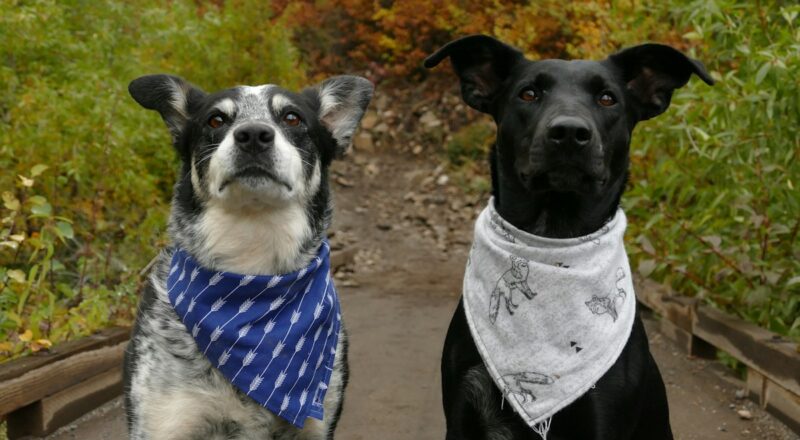
Sublimation is one of those print processes that sounds like a chemistry lesson and turns out to be wonderfully practical. The easiest way to explain it is with a real object, and a small square of polyester worn round a dog’s neck does the job nicely.
Sublimation in five steps
- Prepare the artwork. The design is finalised digitally first. For a pet bandana, that artwork begins with a photo of the animal.
- Print onto transfer paper. Special inks are printed onto paper in reverse, ready to move onto the fabric.
- Bring paper and fabric together. The printed sheet is laid against the polyester and placed in a heat press.
- Apply heat and pressure. Under the press, the inks turn to gas and move into the polyester fibres.
- Lift and reveal. When the paper comes away, the image is in the fabric rather than sitting on top as a separate film.
Why polyester is the usual partner
Sublimation inks bond with polyester fibres, which is why the process is so common for printed sportswear, flags and soft accessories. Cotton does not take sublimation the same way, so fabric choice comes first.
The process in a real product
Take the personalised dog bandana made by Little Red Cute as a tidy example. It is entirely polyester and closes with a buckle, and its design is sublimated, which is to say heat-pressed into the material. Another point in its favour: it is made to be washed.
The pet enters at the artwork stage. A customer uploads a single photo and chooses one of the styles, and out of that comes an illustration of the pet. That finished design is displayed on screen as the proof, and approval is given ahead of payment. No bandana goes near the heat press before then, and each is produced in Singapore for its own order.
Sizes are chosen by neck measurement, in three bands: small for about 35 to 44 cm, medium for 39 to 51 cm, and large for 42 to 56 cm.
Where stock bandanas differ
A bandana printed in a run of thousands carries the same pattern for every buyer. The sublimation method may be the same, but the artwork step is skipped. With a personalised piece, the most interesting part of the job, the image itself, is unique to one animal.
For print fans, a starting tip
Any print professional will tell you the output can only be as good as the input. So feed it a well-lit picture with the face unobstructed and the animal looking roughly at you; a phone camera handles that. Then the heat press has a portrait worth transferring.